Everything you need to know about reverse osmosis
Learn how reverse osmosis systems work, what their benefits are, and how they improve your home or business.
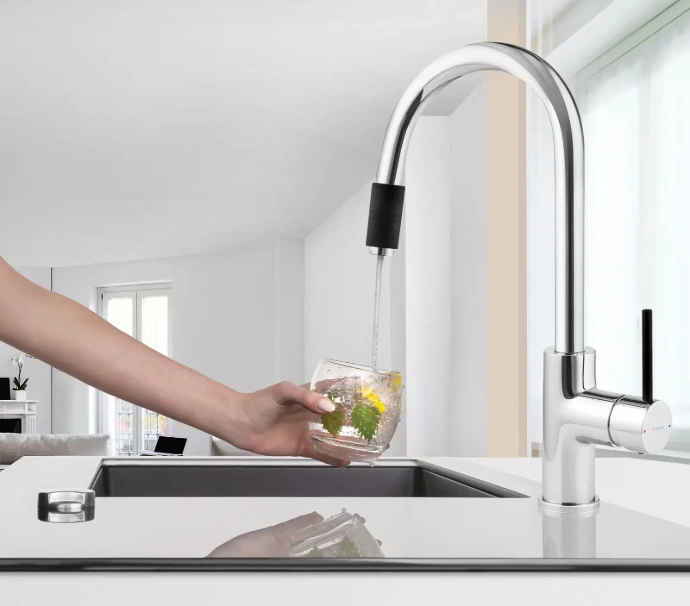
Pure Drinking Water
Removes up to 99% of impurities such as PFAS, heavy metals, chlorine, pharmaceuticals and microplastics for clean, pure drinking water.&c4=o-color-4&c5=o-color-5)
Better Taste & Smell
Eliminates chlorine and chemical residues, improving the taste and smell of your water, coffee and tea.
Safer for Your Health
Reduces harmful substances that may affect long-term health, making your drinking water extra safe for daily use.
Perfect for Cooking & Beverages
Pure water enhances the flavor of food, coffee, tea and baby formula, without unwanted odors or aftertastes.How does a reverse osmosis system work?
A reverse osmosis system purifies your drinking water by pushing it through multiple filter stages and a special membrane. This process removes up to 99% of impurities, so you get clean, safe, and great-tasting water straight from your tap.
Tap water flows in
Regular tap water enters the reverse osmosis system. This water may still contain substances such as chlorine, PFAS, heavy metals, microplastics, nitrates and pharmaceutical residues.
Pre-filters remove the first contaminants
Before the water reaches the membrane, it passes through one or more pre-filters. These remove dirt, rust, sand and chlorine. This protects the membrane and already improves taste and smell.
The RO membrane purifies the water
The heart of the system is the reverse osmosis membrane. This ultra-fine membrane allows only pure water molecules to pass through. Contaminants such as heavy metals, PFAS, salts, nitrates and other dissolved substances are blocked and flushed away as wastewater.
Pure water flows to your tap
The cleaned water is stored in a small pressure tank or flows directly to your dedicated RO tap. You can now use this pure water for drinking, cooking, coffee, tea and baby formula.
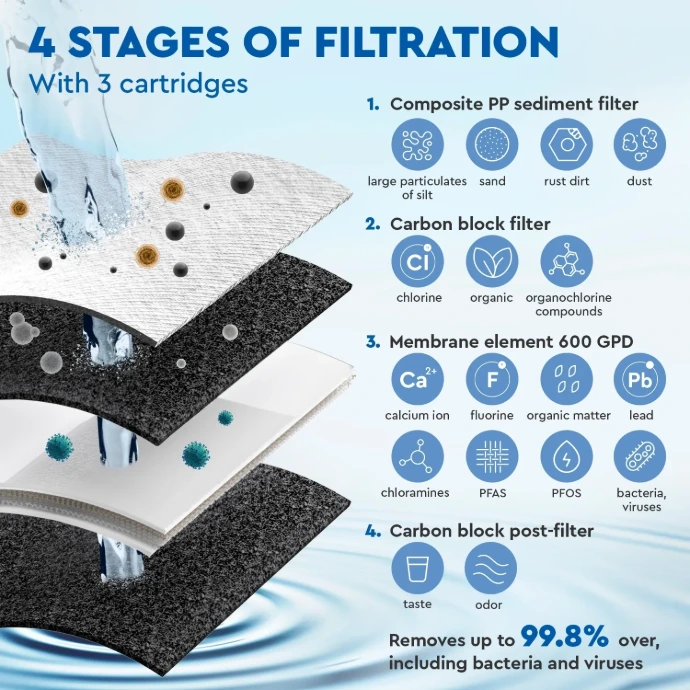
Filter types for reverse osmosis
Sediment Filter (PP / Wound Filter)
Function: Removes physical particles
Removes: Sand, rust, dirt, silt, visible particles
Purpose: This is usually the first filter stage in a system. It protects all following filters and membranes from clogging and damage. Without a sediment filter, other filters would clog very quickly.
Typical lifespan: 3–12 months (depending on water quality)
Activated Carbon Filter (Carbon Block / GAC)
Function: Removes chemicals and improves taste
Removes: Chlorine, pesticides, VOCs, unpleasant odors and tastes
Purpose: Carbon filters use adsorption to trap chemical contaminants. They are essential in RO systems because chlorine can damage the RO membrane.
Two common types:
GAC (Granular Activated Carbon) – loose carbon, good flow rate
Carbon Block (CTO) – compressed carbon, higher filtration accuracy
Typical lifespan: 6–12 months
Reverse Osmosis (RO) Membrane
Function: Ultra-fine filtration
Removes: Heavy metals (lead, mercury, PFAS, Nitrates, Salts, Microplastics, Pharmaceuticals, Bacteria & viruses (to a large extent)
Purpose: This is the heart of a reverse osmosis system. The membrane allows only pure water molecules to pass and flushes away up to 99% of dissolved contaminants as wastewater.
Typical lifespan: 2–5 years
Post-Carbon Filter (Optional)
Function: Final taste improvement
Removes: Any remaining odors or aftertaste
Purpose: After storage in the pressure tank, water passes through this final filter to ensure fresh taste right before it reaches your tap.
Typical lifespan: 6–12 months
Remineralization Filter (Optional)
Function: Adds healthy minerals back into the water
Adds: Calcium, magnesium
Purpose:
Reverse osmosis water is extremely pure. A remineralization filter improves:
Taste
pH value
Mineral content
This is optional but highly recommended for drinking water.
UV Filter (Optional – for Bacteria Protection)
Function: Disinfection
Neutralizes: Bacteria, viruses, microorganisms
Purpose: A UV filter does not remove particles, but destroys microorganisms using ultraviolet light. Especially useful for:
Well water
Storage tanks
Off-grid systems
What reverse osmosis system do I need?
All reverse osmosis systems use the same core technology with multiple filter stages and an RO membrane that removes PFAS, heavy metals, nitrates and other contaminants. The purification level is therefore always very high.
The main difference is in the filter setup and convenience. Some systems use separate individual filters, allowing you to replace each stage on its own. Other systems use combined all-in-one cartridges, making filter replacement faster and easier with fewer parts.
You can also choose optional extras such as remineralization for better taste and balanced pH, UV disinfection for extra biological safety, or different tank sizes depending on your usage.
This way you always enjoy pure, safe and great-tasting drinking water — with a system that matches your preferences for maintenance and convenience.
Step 1: Choose your level of filtration
Every reverse osmosis system already includes the core filtration stages:
Sediment
Carbon
RO membrane
These remove PFAS, heavy metals, nitrates, microplastics, pharmaceuticals and more.
So the water quality is always high — the main choice is how complete you want the system to be.
Optional extras include:
Remineralization (better taste & balanced pH)
UV disinfection (extra microbiological safety)
Additional post-carbon polishing
The more extras you add, the more tailored the system becomes.
Step 2: Choose your convenience level
There are two types of filter setups:
Separate filters – individual cartridges for each stage; more flexibility and control.
All-in-one cartridges – 3 filters combined into one easy-swap cartridge; fastest and cleanest maintenance.
Both deliver the same purified water — the difference is in convenience and maintenance preference.
Step 3: Choose your optional finishing filters
Depending on your preferences, you can add extra filter stages for comfort and safety:
Post-carbon filter – extra polishing for the best taste
Remineralization filter – adds calcium and magnesium back for better taste and balanced pH
UV disinfection – neutralizes bacteria and microorganisms for extra microbiological safety
These filters are optional enhancements and allow you to tailor your RO system exactly to your needs.
Step 4: Choose your tank size (if applicable)
Some RO systems include a storage tank. You can choose:
Smaller tanks – compact, space-saving
Larger tanks – more pure water available at once
This choice depends mainly on household size and daily usage.
Our bestsellers
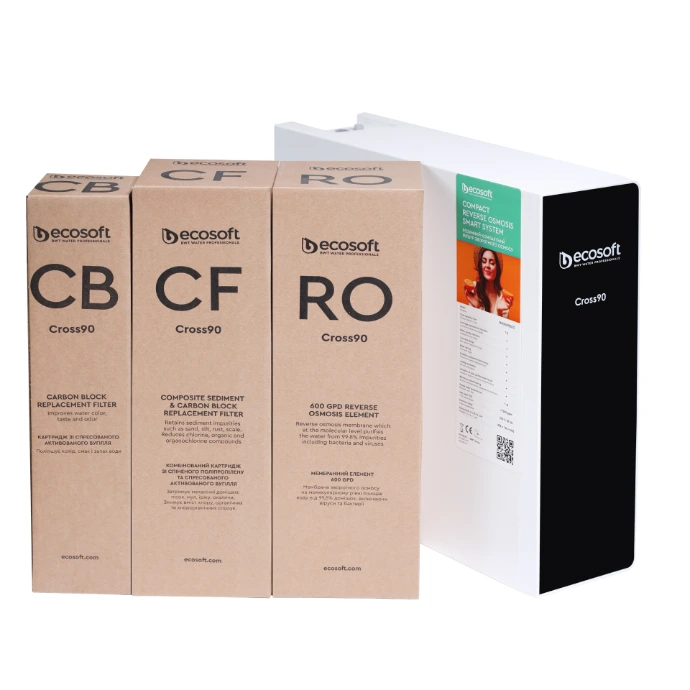
Ecosoft Cross
A modular reverse osmosis system where you choose the filters that match your needs. Reliable performance with full flexibility.
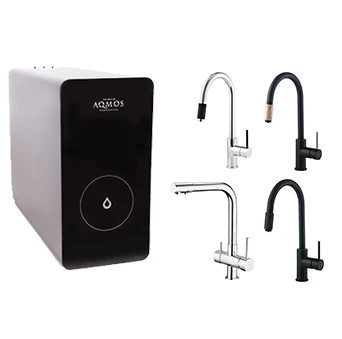
Aqmos All-In-One
A compact all-in-one RO system with 3 filters in 1 cartridge for quick and easy replacement. Maximum convenience in a small space.
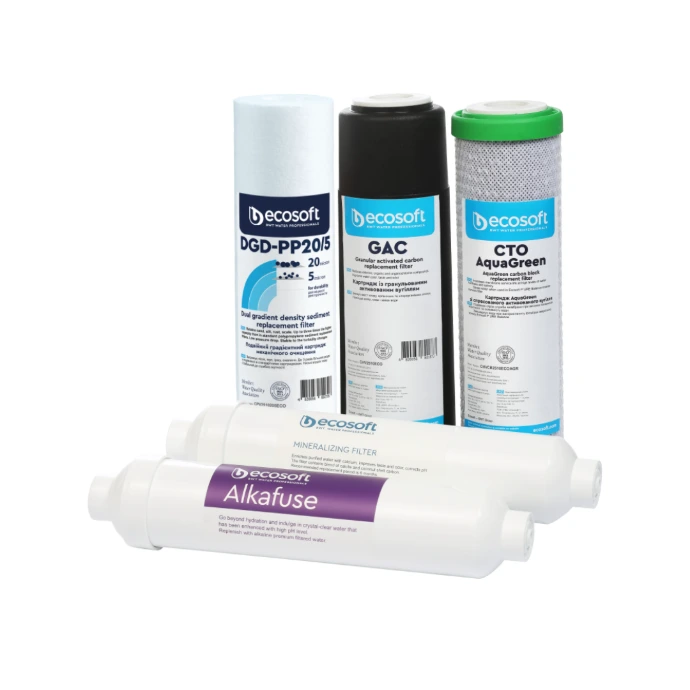
Replacement cartridges
Original replacement filters and cartridges to keep your RO system performing at its best.
Can I install the reverse osmosis system myself?
Yes you can!
Our water softeners are designed for easy installation. If you’re reasonably handy, you can install the system yourself using the included manual. Prefer to have it installed? You can easily hire a local plumber. For a professional installer, fitting a water softener is a straightforward and quick job.
Installation guide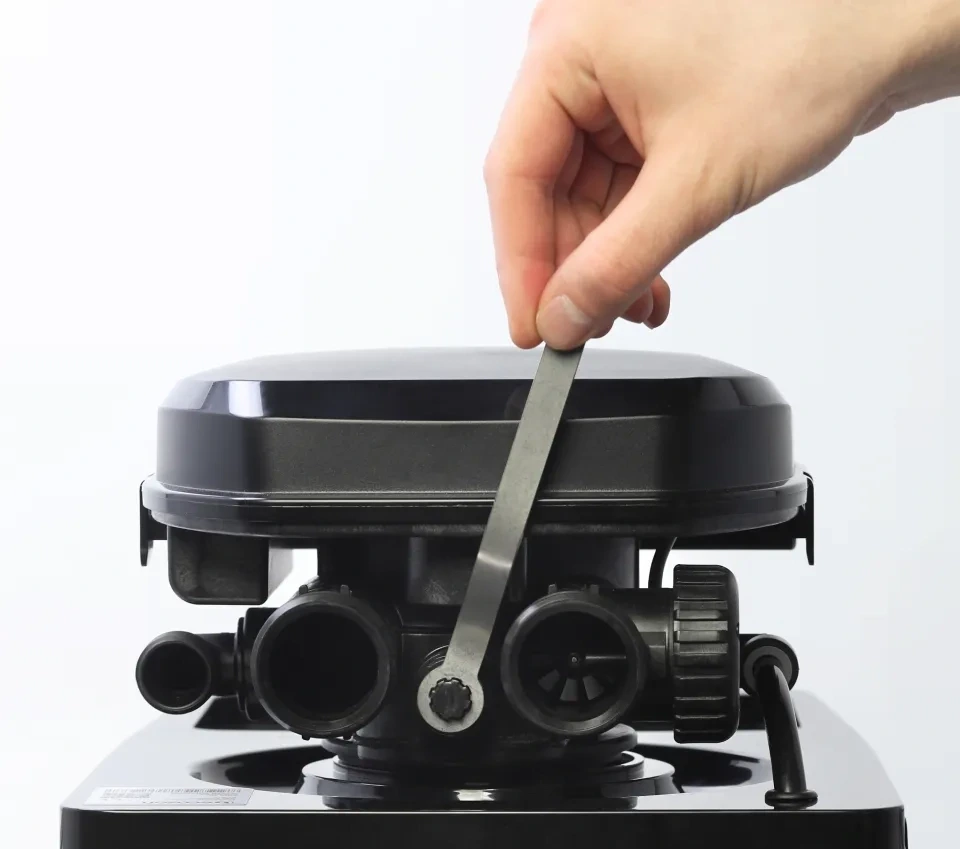
Frequently asked questions
Here are some common questions about our water softeners
General questions
Main advantages:
Less limescale in pipes, boilers, taps and appliances
Longer lifetime and better efficiency of appliances (boiler, washing machine, dishwasher, coffee machine)
Softer water for skin and hair, less soap and shampoo needed
Less cleaning and less aggressive descaling products required
Possible disadvantages:
Purchase and installation costs
Ongoing salt and small water usage for regeneration
Slight pressure loss through the system (usually minimal with the right sizing)
For most households, the savings in energy, maintenance and cleaning, plus the comfort of soft water, outweigh the costs within a few years.
A water softener uses salt and water during regeneration, and the brine is discharged to the drain. In many countries, including the Netherlands, wastewater is treated at a sewage treatment plant before it returns to the environment.
On the other hand, soft water helps:
Extend the lifespan of appliances (less waste)
Reduce the need for descaling chemicals and cleaning products
Improve energy efficiency of boilers and heating elements (less limescale = less energy use)
When used correctly and sized properly, a water softener can therefore contribute to lower energy and detergent consumption over the long term, which is beneficial for both your wallet and the environment.
We are often asked why our water softeners are significantly more affordable than many other brands. The main reason is simple: we don’t add unnecessary margins or fancy branding on top of the same core components.
Many brands use exactly the same control valves, but rebrand them under their own name and charge a premium price. In reality, there are only a handful of manufacturers worldwide producing these valves. We choose to be transparent about this instead of hiding it behind marketing.
We work with proven manufacturers like Clack and Cannature, buy efficiently, keep our overhead low, and use fair margins. That’s how we can offer high-quality water softeners at honest, transparent prices — without compromising on quality.
A water softener removes hardness minerals from the water using a process called ion exchange. Hard water contains calcium and magnesium ions that cause limescale. Inside the softener, the water flows through a resin bed. The resin beads hold sodium ions and exchange them for calcium and magnesium.
The hardness minerals stay behind on the resin, and softened water leaves the unit. When the resin is saturated, the softener automatically regenerates using a brine (salt) solution to rinse the hardness away to the drain. This restores the capacity of the resin so it can keep producing soft water.
From a health perspective, soft water is generally considered safe to drink. It simply contains less calcium and magnesium than hard water. These minerals can also be obtained easily through food, so you don’t depend on drinking water for your daily intake.
Soft water does, however, offer clear practical benefits: it helps reduce limescale in your pipes and appliances and is often more pleasant for skin and hair because soap rinses off more easily.
This is often caused by a change in taste because the calcium has been removed from the water. Most people get used to this new taste within about two weeks. If your water still tastes unpleasant after two weeks, please contact us and we’ll be happy to help.
The only reliable way is to use a water hardness test kit, which measures the hardness in °dH.
Technical questions
During regeneration, a water softener uses additional water to rinse the resin and flush hardness and salt to the drain. For a typical domestic system, this is usually around 50 to 150 litres per regeneration, depending on the model, settings, and water hardness.
Regeneration does not happen every day; the frequency depends on your water usage and hardness. Modern softeners are designed to regenerate only when needed, to minimise both salt and water consumption.
A modern water softener uses very little electricity. Typical consumption is only a few watts – often comparable to a small electronic device or LED adapter. In many cases, the energy cost is well under €1 per month, depending on your local energy prices.
The main operational costs are salt and water for regeneration. These costs are often offset by savings on energy (more efficient heating), longer appliance life, and reduced use of cleaning products.
A salt-based water softener (ion exchange) actually removes calcium and magnesium from the water. The result is truly soft water with very low hardness, which prevents limescale buildup.
A salt-free system does not remove hardness. It conditions the water so that limescale is less likely to adhere, but the hardness value remains the same. These systems can reduce visible limescale to some extent but do not offer the same level of protection as a true softener.
For households with clearly hard water and limescale issues, a salt-based system is usually the most effective and reliable solution.
A single (simplex) water softener has one resin tank. During regeneration, that tank is temporarily busy cleaning itself, so it does not soften water at the same time. Regeneration is normally scheduled at night (for example around 2:00 a.m.), when there is little or no water demand, so you usually do not notice this.
A duplex water softener has two resin tanks. While one tank regenerates, the other continues to supply soft water. This sounds like a big advantage, but in most homes it offers little real benefit because regeneration is already planned at times when no one is using water. Duplex systems are also more expensive and more complex.
For most households, a well-sized simplex system is the most cost-effective and reliable choice.
The most reliable way is to test the water hardness before and after the softener using a hardness test kit. If the hardness after the softener is significantly lower than the incoming hardness, your system is doing its job.
You can also look for practical signs:
Less limescale on taps, tiles, and shower screens
Softer feel of the water when showering
Less soap and detergent needed
If you suspect the system is not performing as it should, start with a hardness test and a regeneration, and contact us if the problem persists.
Salt consumption depends on your water hardness, water usage, and the type and size of the softener. For an average household, a typical water softener uses around 3 to 10 kg of salt per month.
Salt is only used during regeneration to clean and recharge the resin. Efficient models and correctly adjusted settings help keep salt consumption as low as possible without reducing performance. On average, most households need to refill the salt every 3 to 6 months. Checking the salt level once every 2 months is usually sufficient.
No. The resin beads remain safely inside the pressure vessel and cannot enter your tap water. The system is designed so only softened water flows out.
No. Salt is only used during the regeneration process to clean the resin. The salted rinse water is flushed to the drain and does not enter your drinking water.
Condensation can occur due to temperature differences and is usually harmless. You can use a condensation cover to prevent this. However, visible leaks or constant moisture are not normal and should be checked to prevent damage.
This depends on your water usage, water hardness, and the selected capacity. The system regenerates at least every 10 days to prevent bacterial build-up. More frequent regeneration is completely normal and does not harm the system.
Yes, a water softener can slightly reduce your water pressure because the water has to pass through the resin bed. In a properly sized and correctly installed system, this pressure drop is small and usually not noticeable in daily use.
If you already have low incoming pressure or want stronger flow (for example in the shower), you can consider adding a pressure booster pump to your system.
If your household grows or your usage changes significantly, your water softener may regenerate more often. In most cases, your system can still handle this without any issues. If you notice that you have to refill the salt very often you can look at getting a larger system.
Installation, maintenance and selection
Our systems are designed to require minimal mandatory servicing. We recommend:
Regularly refilling the salt
Using a resin cleaner periodically (for example when refilling salt)
Wiping the outside of the unit if it becomes dusty or dirty
Testing the water hardness from time to time
Seals and internal parts can naturally wear over the years (often after 3–5 years or longer, depending on usage and water quality).
We do not offer service contracts ourselves. Many customers manage basic maintenance themselves and only call us if something seems wrong.
Yes, if you are reasonably handy and familiar with basic plumbing, you can install a water softener yourself. Installation involves connecting the unit to the main water line, installing a bypass, and running a drain line.
If you are unsure or do not feel comfortable working on your plumbing, we recommend hiring a professional installer or local plumber. For a plumber, installing a water softener is a straightforward and relatively quick job, especially with a clear manual.
The cost of a water softener depends on the type, capacity and features. For a typical household, the unit itself is usually in the range of a few hundred to around two thousand euros, depending on brand and specifications.
Installation costs depend on the complexity of the job and local labour rates. A simple standard installation is usually much cheaper than a complex situation with extra pipework or special requirements.
Although there is an initial investment, many households recover the cost over time through:
Lower energy usage
Fewer repairs and replacements of appliances
Reduced use of cleaning products and descalers
The right capacity is based on your water hardness (°dH) and your annual water consumption. By combining these two values in the calculator, you instantly see which capacity suits your situation.
No. Bigger is not always better. If your calculated capacity is just above one of the standard ranges (3200, 4800, or 7200), that model is often still perfectly suitable. It will simply regenerate a bit more often.
Warranty
For domestic customers, we offer 10 years warranty on the water softener. We like to keep it simple and transparent – no hidden exceptions in small print.
In practice, this means:
All essential parts are covered against manufacturing defects
If a component fails due to a production fault, we replace it
If repair is not possible, we provide a replacement unit
We support you by phone first, so most issues can be solved quickly
If parts are needed, we send them as soon as possible
We expect that the system is installed correctly, used as intended, and reasonably maintained. Incorrect installation, no maintenance at all, or tampering with parts can void the warranty.
For business customers and trade partners, we typically provide 3 years warranty on water softeners. Defective parts due to manufacturing faults are replaced, and we help with technical support to get the system running again.
Even after the standard warranty period, we aim to find a reasonable, practical solution together. Our goal is long-term cooperation, not one-time sales.
" Write a quote here from one of your customers. Quotes are a great way to build confidence in your products or services. "

" Write a quote here from one of your customers. Quotes are a great way to build confidence in your products or services. "

“After receiving the quotation, I was contacted by phone to receive additional information. I was helped in a very pleasant way! The employee really took the time to explain everything, and I was fully provided with all the information I needed.”

Need help choosing the right system?
Our team is ready to assist you.